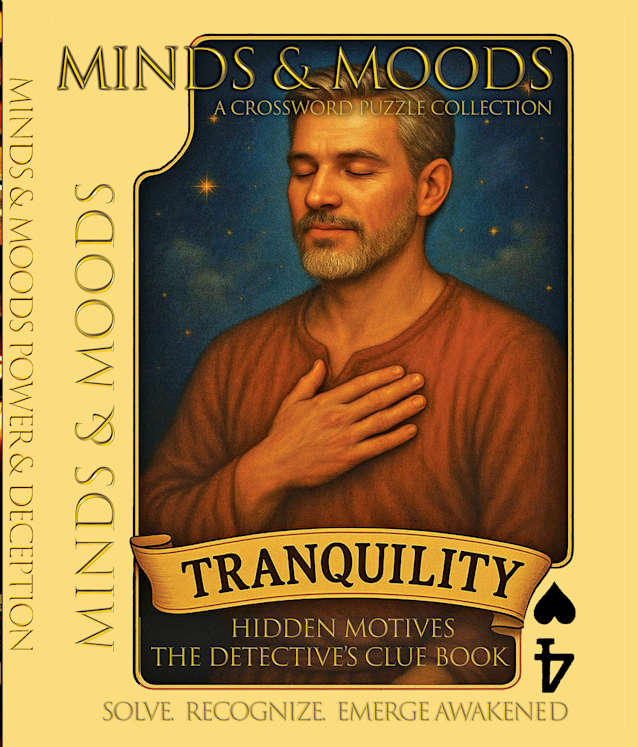
MINDS & MOODS: Hidden Motives
About
We begin in familiar territory, but trust me — we’re about to go way beyond that. Crossword puzzles with deduction — shrewd detective work takes cruciverbalists (folks who love tackling crossword puzzles) into an investigative universe uncovering hidden motives and power dynamics of manipulation and gaslighting. Minds & Moods: Power & Deception invites readers to investigate the inner world like a detective — one clue at a time. Each of the 52 puzzles examines emotional states shaped by control, manipulation, silence, pressure, and the power dynamics that often go unnamed.
Praise for this book
I came across Minds and Moods this week and I have to say, this is one of the most original concepts I have encountered in a very long time.
There is a very specific kind of reader who is going to find this book and feel like it was made for them. Someone who has always loved crosswords but found most puzzle books ultimately empty. Someone who is drawn to psychology and power dynamics and the invisible forces that shape human interaction but does not want to be lectured at about them. Someone who finds that their mind works best when it has something concrete to solve. Minds and Moods sits at the precise intersection of all three of those things and does not ask permission for that ambition.
What drew me in specifically is the framing of each clue as a micro-scene. Not a trivia question. Not a vocabulary test. A moment of pressure, silence, manipulation, power imbalance, or emotional confusion that has to be decoded rather than simply recalled. That design choice is doing something genuinely unusual. It is using the act of solving as a way of naming things that normally go unnamed, and the observation that emotional tension settles while deductive reasoning comes online is the kind of insight about how minds actually work that most puzzle creators have never thought to build around.
This is not a self-help book is also exactly the right thing to say. The readers who need this book most are often the ones who are most skeptical of being told what to think or how to feel, and a book that offers recognition rather than advice is going to earn their trust in a way that more prescriptive approaches never could.